
Finding Otero County Recent Arrests
Otero County publishes no verified sheriff roster, same-day booking feed, or rolling arrest log. Start instead at the Otero County government site, which links to the sheriff and jail. Those pages sit behind access restrictions. They cannot be relied on for an online list. The dependable fallback is calling the Otero County Sheriff's Office at 719-384-5941. Ask whether a named person is currently in custody, and when the booking was entered. Ask which office holds the arrest record.
That gap matters. It does not mean no arrest happened. It does not mean the county hides custody data. It means no private page should pose as the county's source. A recent arrest moves through several systems at different speeds. Police write the report. The jail opens the booking record. VINE may receive custody data. The court then adds case and hearing entries to its docket. Each channel answers one question. Only together do they tell the full story of who was arrested in Otero County.
| Window | Verified Otero source | Best official action |
|---|---|---|
| Same day | No public county feed verified | Call OCSO and use Arrests Last 24 Hours for the fallback order |
| Several days | No rolling county blotter verified | Check police publications, then use the Police Blotter records path |
| Ongoing custody | Colorado VINE participation requires a live check | Use the VINELink Custody Check and verify with OCSO |
Otero County Arrest Roster Gap
The official Otero County Jail page carries the right government web address. It displays no searchable roster or current-custody results. The sheriff's older domain is likewise inaccessible. Private directories repeat the jail phone number. They are not record custodians, and they cannot confirm who is held. Here the official phone line beats any search result wearing county branding. A written request works the same way.
A good request names the person and the date range. It then asks whether the jail keeps and can release specific booking fields. Do not assume every field is public or online. Juvenile data may be withheld. So may victim and witness details, medical information, and full birth dates. Fingerprints and sealed material may be withheld under the same rules.
| Field to request | What it can clarify |
|---|---|
| Name and booking number | Identity and the jail’s file reference |
| Booking date and arresting agency | When custody processing occurred and who made the arrest |
| Charge and bond as booked | The charge and initial release condition |
| Custody, release, or transfer | Whether the person remains there or moved |
| Booking image status | Whether a photo exists and is releasable |
Keep the sequence short. Open the official jail route first. Second, call 719-384-5941. Third, ask for the current CCJRA request method and the custodian. Ask about any fee and a response estimate too. Fourth, write down the date and source of whatever answer you receive. The sheriff's office offers no booking app and no social booking feed. Its social accounts carry safety news rather than a full arrest roster.
The official county entry point shows where the sheriff route begins.
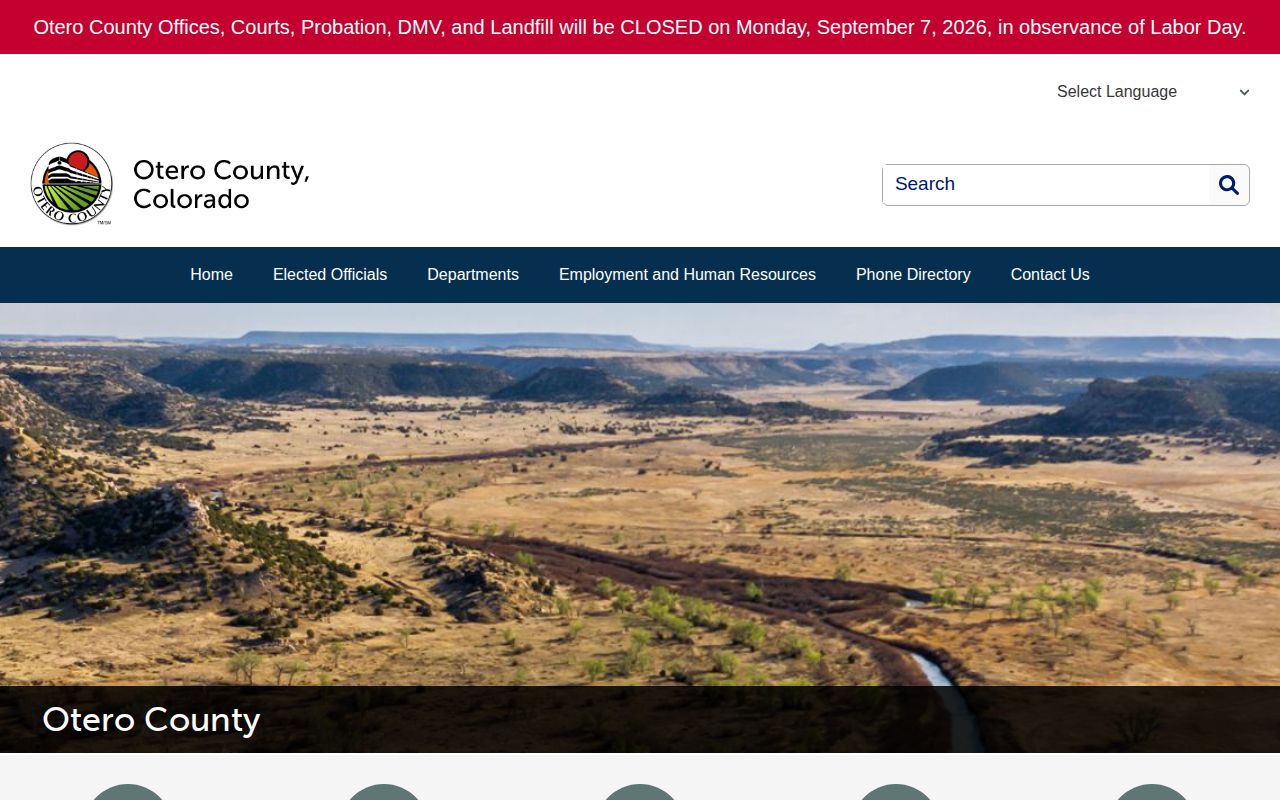
Note: The image shows the county government domain itself, without implying it lists current names or booking photos.
Otero Arrest Logs Differ by City
Each Otero County city handles arrest information its own way. La Junta Police posts a monthly dispatch bulletin. Entries can include an event number, date, time, call type, city area, and disposition, sometimes reading "CLEARED ADULT ARREST" or "WARRANT ARREST." It is not a jail roster, though. The department warns the original call type may differ from the final outcome. Juvenile details, sexual-assault matters, and medical calls are withheld.
Rocky Ford Police publishes weekly activity summaries. Those graphics show aggregate counts for calls, reports, arrests, traffic stops, crashes, and code matters, not a named booking list. Fowler Police posts no public arrest log. Its alternative is a criminal-justice records request form. These differences are exactly why an Otero County search needs city context, and why the three police sources cannot stand in for one custody database.
The La Junta Police bulletin page shows the monthly report and its privacy limits.
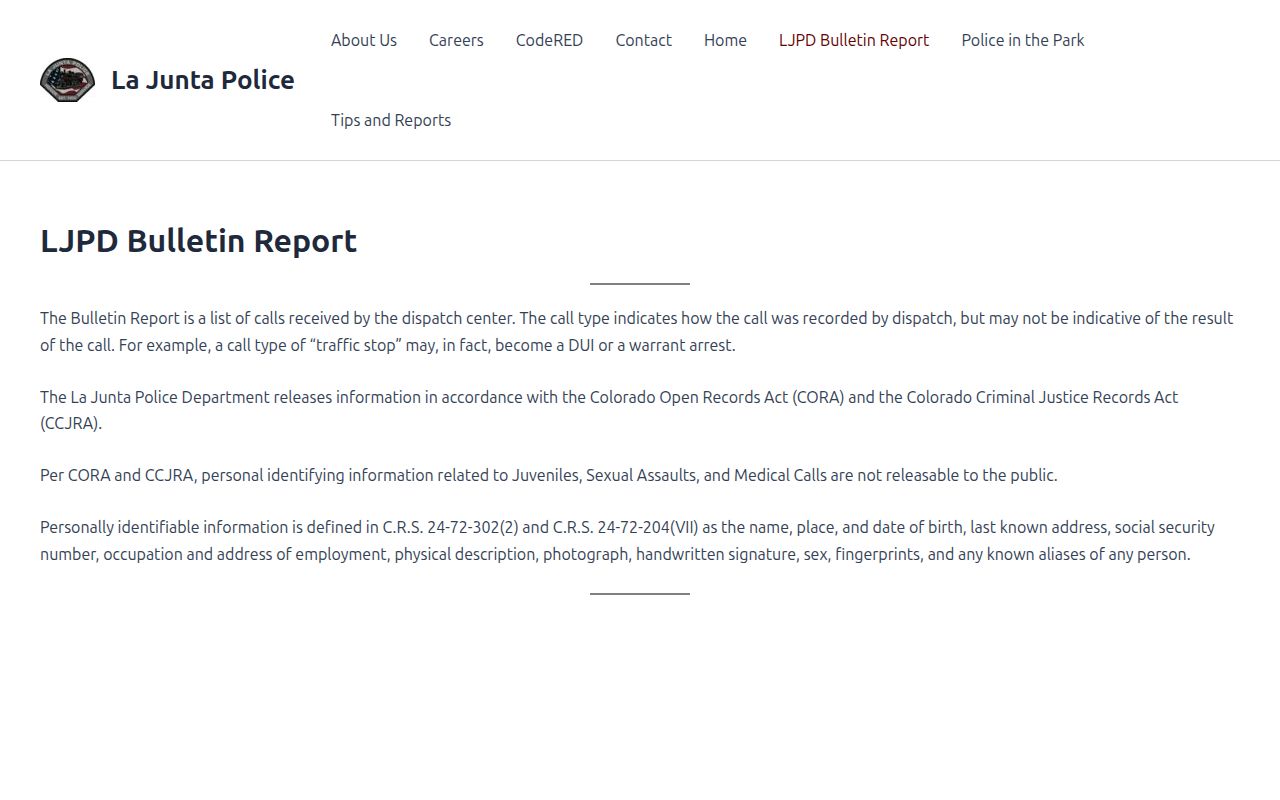
Note: This view separates dispatch events and arrest dispositions from actual Otero County jail custody.
Otero County Recent Arrests by City
The city routes connect local police records to the county booking system. La Junta Recent Arrests walks through the monthly police bulletin and the county-seat booking path. The Rocky Ford page covers weekly aggregate reports. It also maps its CCJRA request channel. And it notes cases housed outside Otero County. Fowler's page explains its detailed request form and the absence of any public named blotter. A city police report documents an incident or an agency's action. The Otero County Jail holds the separate booking file when it accepts the person.
- La Junta Recent Arrests: city bulletin dispositions and LJPD records.
- Rocky Ford Recent Arrests: weekly totals and Rocky Ford Police requests.
- Fowler Recent Arrests: Fowler Police records forms and county custody checks.
Check the booking destination case by case. One reported Rocky Ford arrest, for instance, used Bent County Jail. That fact does not turn Bent County's custody source into an Otero-wide roster. It shows why each stop matters. The arresting agency, the actual facility, and the court location should each be recorded.
Inside an Otero Arrest Record
A booking record begins the moment a person is processed into jail. It is not the police incident report. Nor is it the court complaint or a final judgment. Otero County records may hold identity details, the arresting agency, the booking date, alleged charges, and bond. They may also show custody changes and a photograph if one was taken and may lawfully be released. The sheriff's office publishes no field list. Request these items rather than treating them as guaranteed online fields.
- Booking
- The jail’s intake process and custody record.
- Bond
- A court-set release condition.
- Arraignment
- A court appearance where charges and pleas are addressed.
- Disposition
- The later result of the court case.
- Expungement
- A legal process most often associated here with qualifying juvenile records.
Time stamps pull in different directions. The moment something happened, the moment an officer made an arrest, the moment jail staff booked the person, the report date, and the first court date can all sit far apart. Treat each one as its own fact. Names need the same care: a match in a bulletin or custody system may point to someone else entirely, and a booking number should never be guessed from a news story.
Otero County Mugshots After Arrest
Start with the sheriff's office. No OCSO policy puts every booking photo online. So the direct route is to ask whether a photo exists for a given booking and whether Colorado criminal-justice records law allows its release. Reporters do publish booking images from time to time. They usually name the jail that supplied the picture. Treat that as selected coverage, not a complete feed.
Know your source before trusting a photo. SECO News credited one Fowler arrest image to Otero County Jail. A Rocky Ford story went to Bent County Jail. An image from the Colorado Department of Corrections locator belongs to a state offender record, not an Otero booking. Federal and immigration locators deserve the same caution. A private Otero archive still circulates online, but it skews toward older years and may be incomplete or simply wrong. Its entries prove nothing about who is in custody today. Check with the sheriff, the courts, or VINE first. The Federal Bureau of Prisons locator shows how a federal custody search works as its own separate channel.
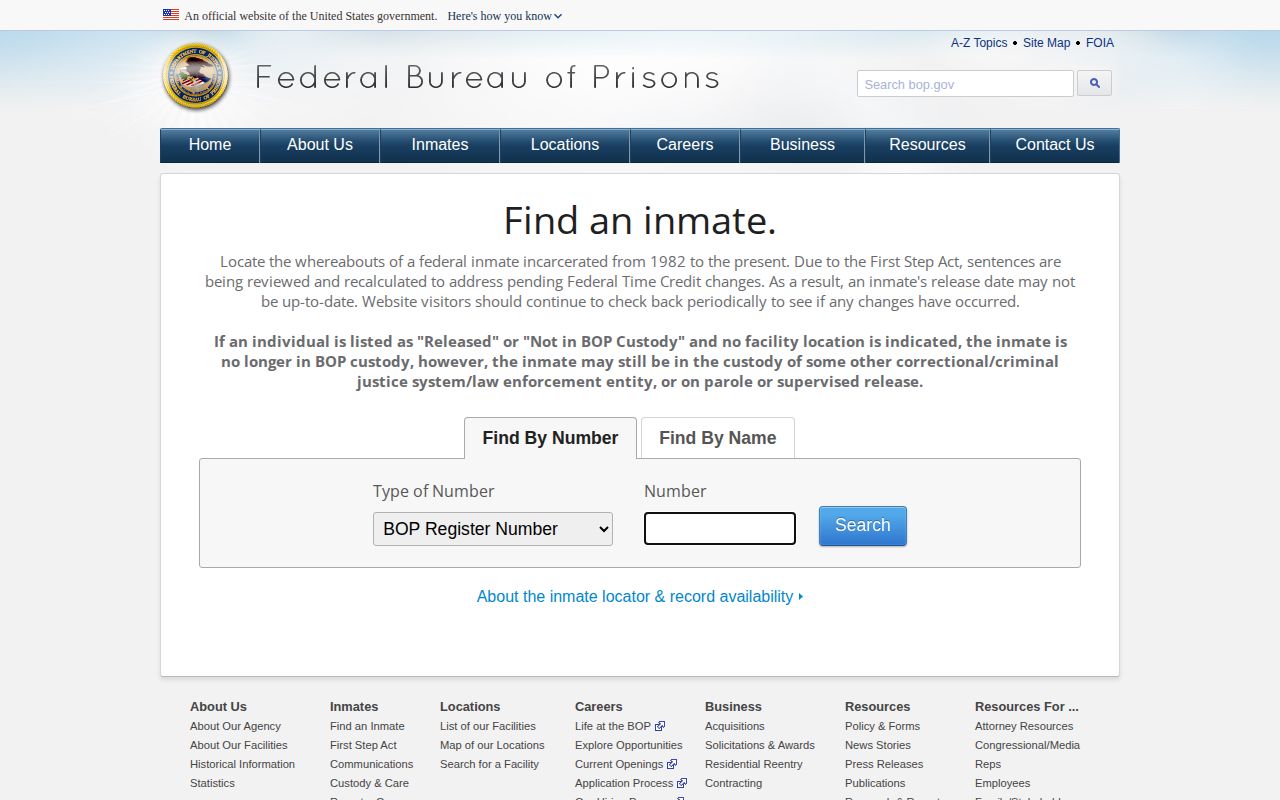
A federal search will not confirm a new Otero County booking or reveal the county's photo policy.
Requesting Otero County Arrest Records
Colorado splits its records law in two. Ordinary public records fall under CORA, while criminal-justice records answer to CCJRA. That distinction decides where a request goes. A jail booking request belongs with OCSO. City incident reports go to the police department that wrote them, and court copies travel through the Otero Combined Court. The OCSO fee schedule, response estimate, email route, and photo policy are not posted, so confirm each one before you send personal details or payment.
- Identify the custodian: sheriff for booking, city police for incident records, or Judicial Branch for the case file.
- Give a precise name, date range, agency, and record type. Request only the fields needed.
- Ask about redactions, inspection, copy format, search fees, and the response date before paying.
- Keep the request, response, source URL, and access date together so later changes can be traced.
Fowler offers a helpful point of comparison. Its form lists $0.25 per page for reports. It charges $41.37 per hour for search and retrieval past the first hour, subject to change. Those numbers apply only to Fowler, never to OCSO. Rocky Ford routes closed-case criminal-justice requests through its city process, and La Junta's contact channel handles case-specific questions beyond its monthly bulletin. For the statewide framework, the Colorado Attorney General's records guidance walks through how CORA requests work.
It routes the request but never decides what gets released.
Colorado Arrest Photos and Removal
Colorado sets the rules for booking photos. The Colorado Criminal Justice Records Act governs access to many criminal-justice records, and what gets released depends on the record, the custodian, and any protected information inside it. One provision, C.R.S. § 24-72-305.5, targets direct solicitation and fee-based removal schemes tied to booking images. It does not make every photo public, though. Nor does it prove the sheriff posts Otero booking photos online.
Fixes start at the source. The Colorado Judicial Branch offers Seal My Case guidance, with separate tracks for arrests that drew no charges, automatic sealing, county or district convictions, municipal convictions, and juvenile expungement. Eligibility and effect hinge on the case. A sealing order is not a magic eraser either. News stories, private archives, and search indexes can keep old copies.
Want a copy from a private site? Only use a verified free correction or opt-out policy. The stale Otero archive lays out a free evidence-based path in its record-maintenance policy. Never pay a company that solicits money to remove a booking image. Once the source changes a page, a search engine's outdated-content tool can handle lingering results, and keeping court orders plus source responses helps if disputes arise later.
Otero Arrest Warrants and Wanted Checks
Otero County posts no online warrant portal. The sheriff also keeps no current most-wanted list. The court docket does list an "Appearance on Arrest Warrant" hearing type, but that is one court event, not an active-warrant database. For a specific matter, call the Otero Combined Court at 719-384-4951. OCSO takes warrant questions at 719-384-5941. Qualified counsel can help too.
Safety comes first. Never approach, follow, or confront someone thought to be wanted, and never publish a location. Call 911 for immediate danger. An old private index can still show a warrant long after it was recalled, and the Otero court docket displays the hearing filters used after an arrest.
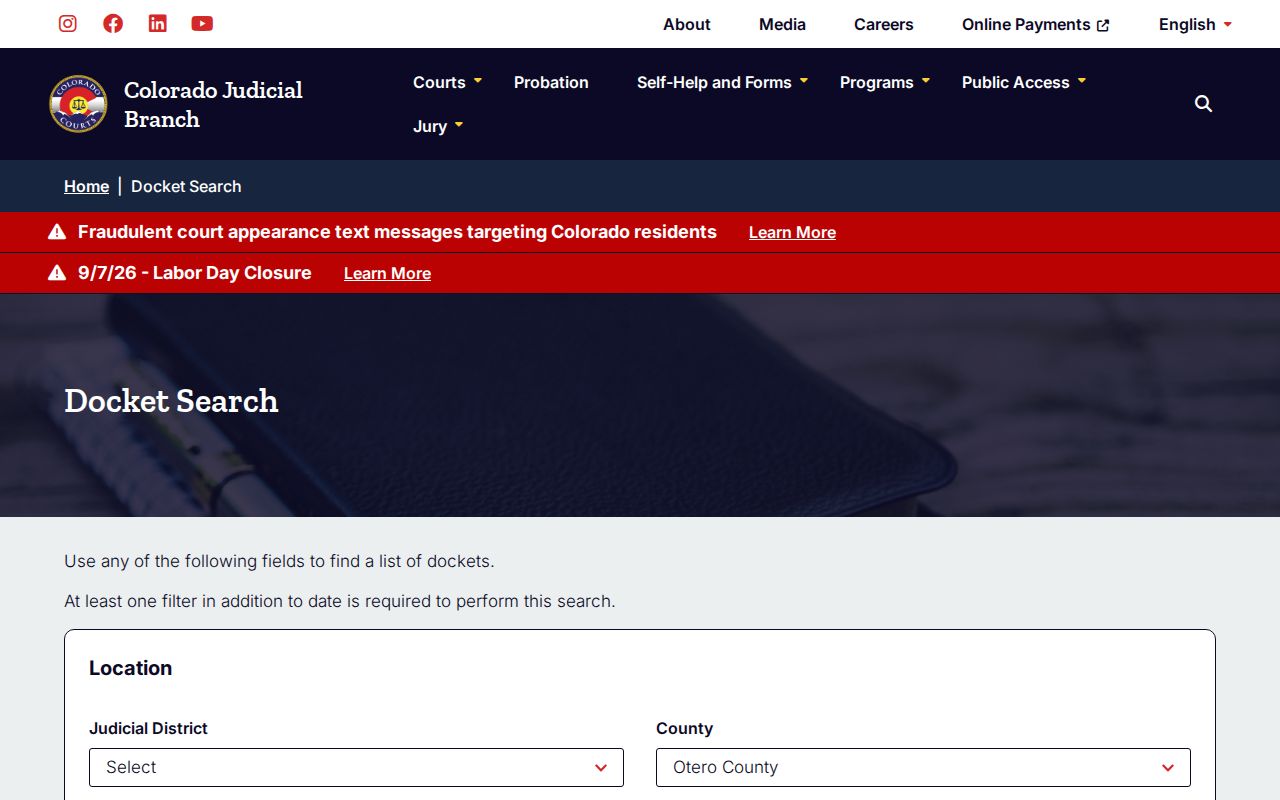
Custody still requires a separate jail or VINE check.
Otero Arrests Move to Court
Otero County sits in Colorado's 16th Judicial District. Bent and Crowley Counties share it. The Otero Combined Court docket tracks what happens after an arrest. Think advisements, arraignments, warrant appearances, sentencing events. Filters cover location, court type, case number, party, and date range. A fresh booking can exist before any searchable hearing, while a court file may persist long after release.
The county court page also lists weekend bond hearings. That bridge matters when the jail has no online feed. Confirm custody with OCSO, then follow the case there. A bond hearing sets release conditions. The final disposition shows whether charges were dismissed, changed, or resolved.
A facility transition adds another wrinkle. Reports describe a new detention-center project and a sheriff administration move. Old jail pages may carry stale entrance, capacity, visitation, or operations details, so call ahead and ask whether older booking records and images stayed in one system after the transition.
Otero Arrest Records by Custody Stage
An Otero County arrest record moves through several hands. Right after the arrest, the police incident report and the jail booking are the most direct records. A VINE entry may follow. It appears only if the holding facility participates and transmits the booking. Release ends physical custody at that jail. The booking record stays. Nor does it close the court case, since a later DOC placement falls to the state system while a federal hold falls to a federal one.
| Stage | Best source | What a result means |
|---|---|---|
| Just arrested | Arresting police agency and OCSO telephone | An event or intake may exist before other databases update |
| Held locally | Otero County Jail and live VINELink check | Current custody at the time checked, subject to transfer |
| Released | OCSO booking request and Otero court docket | Local jail custody ended, but charges and hearings may remain |
| State sentence | Colorado DOC locator | A state corrections record, not a fresh county roster entry |
| Federal or ICE custody | BOP or ICE locator | A separate federal status with different search fields |
A "not found" result is not the end. Maybe the person was released or transferred. Names get misspelled at booking. The arrest may have happened in another county, or too recently for the service to update. Call the facility before concluding anything. Write down each check's time, since custody can change within a day.
The Otero County sheriff lists no jail app. Sheriff-linked social channels work as public-safety and agency-news outlets rather than booking tools. Colorado VINE is the better notification route for a participating local facility, though its result still deserves a check against OCSO. Police social posts, reverse-911 messages, and incident notices serve a different purpose and cannot build a full arrest list.
Otero Arrest Records Withheld by Law
Not every field in a booking file is public. La Junta Police gives a clear local example. Its bulletin policy withholds identifying information on juveniles, sexual-assault matters, and medical calls. Personal data may also require protection. That includes a full birth date, home address, photo, or fingerprint. A private copy does not erase those limits. Ask for a releasable record, not an unredacted file. Redaction strips protected text or images before release. If a custodian withholds part of a request, ask for the legal basis and whether the rest can still be inspected. Never use an unofficial archive to restore what the official source lawfully withheld. The same caution applies after a court seals a case. Expungement of a qualifying juvenile record works the same way. Note: A public arrest fact does not make every related identity, medical, victim, juvenile, security, or court-sealed detail public.
Otero Custody Beyond County Arrest
The DOC locator covers state prison and community-corrections records. It may show a state offender photo. Corrections number, physical description, conviction, and release information can appear as fields. A fresh Otero County booking is not its subject. Someone may be released from county jail, transferred elsewhere, or never enter DOC custody at all.
Federal custody runs on separate tracks. The Bureau of Prisons locator searches its own population, not county jail intake. ICE's Online Detainee Locator handles immigration detention through an A-number or exact biographical match. A blank result in any system does not mean no Otero arrest occurred.
Archives add a final layer. Current jail records start with OCSO. Court files sit with the Judicial Branch. The Colorado Historic Newspapers Collection holds old reports. State Archives finding aids include broad county-jail record terms, but no modern Otero booking-photo series appears there. A focused archival request should name Otero County, the agency, record series, date span, and desired format.
Note: Current custody, a city police event, a court case, and an archived news report are separate records with different update cycles.